Pages

Thursday, 1 May 2014

A Lotus Bloom or Doom in 2014?


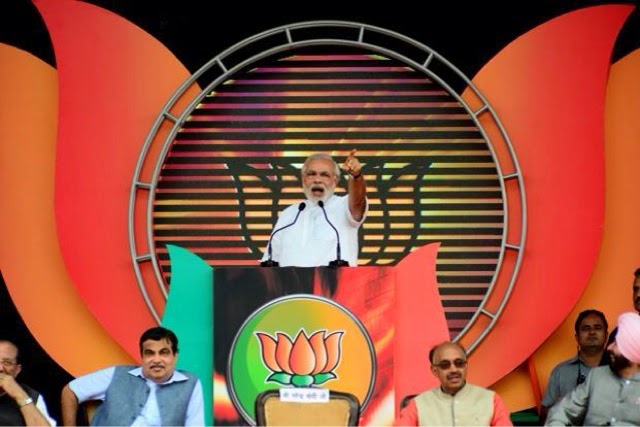
The whirlwinds in the political corridors of the country started gaining momentum as soon as the Bharatiya Janata Party anointed their Hindu Nationalist leader and Chief Minister of Gujarat, Mr. Narendra Modi as their official Prime Ministerial candidate. This move as speculated resulted not only in tilting the entire campaign towards a more Presidential style of elections, centered around an aggressive Modi but also led to huge polarization among the voters. With the slogan of 'Abki Baar Modi Sarkaar', BJP has put in all their efforts to reap as many political brownie points as possible by hard selling their poster boy. 


But one needs to understand that elections cannot solely be won on the basis of slogan chanting or by the personality cult of an individual. The lessons could be well learnt from our neighbors where a relatively timid Nawaz Sharif defeated a much more bold and aggressive Imran Khan in the national elections which happened last year in Pakistan. After all, not everybody possesses the charisma of former Prime Minister Indira Gandhi, who would stand on a dais, clad in a khadi sari, and cheer the slogan of ‘Garibi Hatao’, and people would realize that their messiah has come. So while everyone in his party and that of the allies are trying to bask in the glory, they should be careful to not tan themselves. 


Throughout the election campaign, if you analyze closely, BJP has had a two point basic agenda. One, to hard sell Brand Modi by projecting him as ‘Vikas Purush’ and two to polarize the polity by using the various constituents of the Sangh Parivaar who very effectively and silently have been doing their ground work in the crucial states of Bihar and UP where the blurring of caste equations can lead to huge consolidation of Hindu votes. So it's not surprising when we heard the news of rioting in Muzzaffarnagar where Jats and Muslims have lived peacefully for years or while suddenly the news of communal tension hits our TV screens and curfew imposed in Kanpur after there was reports that veteran BJP leader Murli Manohar Joshi might be losing out the battle to Congress's Sriprakash Jaiswal. 


With all the major opinion polls projecting a lotus bloom and rout of the Congress in this general elections, it is important to look at some ground realities before we jump to conclusions. Being someone who has been constantly talking to people from key states and travelling across India for various activities, I could see a very different picture from what has been so far projected by the media as a big Modi wave across the country. Is the big hullabaloo about the so-called 'wave' actually translating into votes? Or it might just leave the party in an awkward position where while the number of seats does increase but it doesn't help to catapult them to grab power at the centre. Then what is the actual scenario that is being developing in the political landscape of the country as half the country has already voted to decide the fate of the next government? Let us have a look.


First, let us analyze the crucial projection of seats across the country with special emphasis on the Hindi heartland where they are heavily banking on. These projections that I would be presenting are based primarily on how equations are fast changing as elections come close to an end. Even with a grand alliance of regional parties in Tamil Nadu, return of BS Yedduruppa in Karnataka, stitching a tie-up with Chandrababu Naidu's TDP in Andhra Pradesh and with Narendra Modi himself addressing so many rallies in Kerela, the prospects are not so bright for the saffron party in the southern part of the country. While in Kerela it might not even open it's account, in Tamil Nadu, they can't win more than 2-5 seats. 


Similarly Yedduruppa's entry has failed to change dynamics in Karnataka and therefore cannot help win more than 10-12 seats out of 28. In Andhra Pradesh and Telengana too, the total tally for the party might not cross 2-5 seats, thereby giving BJP a total of 20 seats from South India. Coming to East India and the north-east, it looks like the Modi wave hasn't change anything much and the states are sticking more and less to the same old players. In the north-east except for Assam where they can hope for a maximum of 5 seats to their kitty, in most other states, they'll struggle to win even a single seat. In the eastern states of West Bengal and Odisha, Mamata Banerjee and Naveen Pattnaik would hold key to most of the seats leaving BJP with not more than 5 seats from both the states even if they see a rise in their vote share. Chattisgarh and Jharkhand are however two states where BJP would make huge gains and can end up winning 7-8 seats out of 11 and 6-7seats out of 14 respectively.


Now coming down to the western and northern states where the BJP is heavily banking to ride on the Modi wave, the grass is not as green as it appears to be on the other side of the fence. In Maharashtra along with allies Shiv Sena and RPI, the party is hoping to win as many as 35 seats. However latest ground reports suggest that the voting pattern hasn't much changed in the state and while a seat or two might flip to the other side, the voters are still sticking to the Congress-NCP alliance. This leaves them with not more than 20 seats in the state. States where they'll make huge inroads are Gujarat, Madhya Pradesh and Rajasthan where they can win more than 20 seats each.


However it's the northern part of the country that matters the most. In Punjab huge anti-incumbency and an aggressive campaign by Capt. Amarinder Singh is giving a very tough time to the BJP-SAD alliance. In Haryana too, despite anti-incumbency setting in, the Hooda govt appears to be better placed and BJP can expect not more than 5-6 seats out of the state’s 14. Also in the hilly states of Uttarakhand, Himachal Pradesh, Jammu and Kashmir, the party can expect not more than 8 seats in total.


In Bihar out of the 40 seats, BJP was expecting that the Modi wave will blur caste lines and bag more than 25 seats. That clearly is not happening. Lalu has made a grand comeback and the Congress-RJD-NCP together with their M-Y duo is expected to win many seats and be edge to edge in many others. Nitish Kumar's JD (U) though hugely losing ground will play a major spoiler with his Kumri and Mahadalit vote banks consolidating towards his party. Then how many seats are they winning in Bihar? My estimate is not more than 18 and I'm being very humble as in many parts especially North-east Bihar, there is clearly no Modi wave.


There is a very popular saying in politics that the road to Delhi goes through UP. It is the state which sends most number of MPs to the parliament and every party has huge stake in it. With Narendra Modi himself fighting from the state, the fortunes of BJP depend hugely on how it fares in India's largest state. With a plethora of strong regional parties like SP, BSP, RLD etc the final results might just throw a lot of surprises than what majority of opinion polls has to say. And mark my words, it is only when the results of UP would be announced, will suddenly the media wake up to the political prowess of Mayawati. They might end up bagging maximum number of seats, but again, my projection says they can't cross 20-25 and that is solely because of the so-called Modi wave. 


So, with these projections, where do we leave BJP when seen in totality? My prediction is that with the help of the Modi wave, if there is any, the party will not cross more than 165-180 seats. Rest will depend on how they stitch their alliances with key regional players. With major players like Mayawati, Mulayam Singh Yadav, Mamata Banerjee, Naveen Pattnaik, K Chandrasekhar Rao etc taking a hugely anti-Modi stand, the going is really tough for the party.


Secondly, despite the odds being in favor of BJP, four key leaders in the party are facing their toughest battle yet. First in the row is Arun Jaitley.  Erstwhile seen as a safe seat, the rumors were that he would be seen only twice in the constituency, once to file his nomination and next to collect his winning certificate. But the entry of former Punjab Chief Minister Capt Amarinder Singh on Sonia Gandhi's insistence has made him stay there ever since. The fight is so edge to edge that Jaitley has called in his entire family and all his intellectual friends from Delhi to campaign for him. The empty chairs that greeted Modi in his recent Amritsar rally perhaps bear testimony to what is coming. Veteran leader Murli Manohar Joshi after being shifted from Varanasi is facing a formidable Sriprakash Jaiswal in Kanpur and ground reports suggest that he seems to have an edge over Joshi. 


The third leader in the fray is party President Rajnath Singh who too shifted base from Ghaziabad to Lucknow and is repeatedly invoking memories of Vajpayee to win over the voters. However Congress's Rita Bahugana Joshi is giving him a run for his money as the 4.5 lakhs Muslim votes is hugely consolidating in her favor and there are the other traditional Congress vote banks too. What is most interesting is the challenge that Narendra Modi faces in Varanasi. Though the odds are in his favor and he clearly has an edge over his opponents. The withdrawal of don-politician Mukhtar Ansari's nomination to ensure that the secular votes don’t split can play a huge spoiler for him. Congress's Ajay Rai who claims to be a local has considerable amount of support in the holy city. And then we have Arvind Kejriwal who too if sources are to be believed is gaining huge grounds with each passing day.  


At a time when there is huge anti-incumbency in the country, the much hyped Modi wave is not seemed to be gaining as much as it is projected by the media. BJP's hope to cut across caste equations and consolidate Hindu votes in its favor is clearly not working perfectly. On May 17, the very next day when results of the general elections will be announced, the front page of all the leading newspapers will bear the picture of Narendra Modi, either lauding his success and charisma or narrating his doom. While we were shooting for our documentary ‘The Gujarat Promise’ in Juhapura, I asked an old woman about what she has to say about Modi, and she replied 'There are good people. There are bad people. And there is Narendra Modi.'. While we are smart enough to read between the lines and interpret the statement both ways, it kind of sums it all.


For all sorts of bouquets and brickbats, feel free to leave a comment below or mail me at author.vish94@gmail.com 

Monday, 7 April 2014

An empty Pandora’s Box


On this day of 7th April 2014, we would yet again create history as the world’s largest democratic process will kick start from Assam and Tripura while nearly 815 billion voters are ready to cast their vote. If news channels, their opinion polls and BJP’s Prime Ministerial nominee Mr. Narendra Modi’s claims are to be taken into consideration, then they’ve already won the elections. Oh no, I was not referring to the tampering of EVM machines in Assam recently where even if you vote for the Congress, the vote automatically goes to the BJP. Probably it is this sheer confidence of Mr. Modi and his party that they thought that releasing a manifesto and shelling out their vision and policies on issues of prime importance too mainstream. They finally decided to have some mercy on the voters of this country and finally released it today. Yes, on a day when polling begins.

But even after taking so long to release a manifesto and being attacked severely by the opposition, the BJP manifesto appears to be too bleak and shallow when it comes to suggesting strong economic reforms or even welfare schemes for the poor. Despite huge sections of it being shamelessly picked up from the Congress manifesto, so much so that even the date appears to be 26th March 2014 (the same day when Congress released its manifesto), the manifesto hardly finds any mention addressing key problems faced by the farmers and labourers which constitute the majority of Indian population. While the manifesto gives huge descriptions when it comes to corporates for obvious reasons, sections such as agriculture, labour, water, energy, science and technology and environment are hugely neglected with mere token mentions. Let us now look at some of the key highlights of the BJP manifesto and the kind of policies they want to implement and their past stand on that. After all, it has had a history coloured with hypocrisy and double standards.

The manifesto which starts with the tagline ‘Ek Bharat, Shresta Bharat’ though have nothing to resonate with its history both in its current capacity and its earlier avatar as the Janata Party or Jana Sangh, goes ahead promising to strengthen Panchayati Raj institutions, the passage of the very same bill which it opposed earlier saying that it was a conspiracy by the Centre, an attack to the federal structure and an overburden to the state expenditure. It further goes ahead promising to promote north-eastern states and its growth while it deprives the people of this region from their policies as they go for polls without even knowing what vision they have to run the country. Nothing can be more insulting then this to the voters of this region where the voter turnout today reached almost over 80%. Another shallow and disturbing point in their manifesto is about Article 370 which merely says that a discussion with stakeholders committed to its abrogation shall be held in Jammu and Kashmir. In what context and in which capacity, no one really knows. It also promises to send all Kashmiri Pandits back with dignity, a point which is nothing but laughable given their track record of handling refugees during the ugly riots of 2002.

As we move ahead, we come across a tiny line which promises to setup strong Lokpal institutions in the country. We all know how cunningly Mr. Modi fought tooth and nail to avoid the setup of an independent Lokayukta in the state of Gujarat and how BJP initially didn’t let the Lokpal Bill pass in the Rajya Sabha after it got passed in the Lok Sabha. It also promises to reduce the number of cases where government is a litigant. This coming from a party whose Prime Ministerial candidate, in the capacity of being the Chief Minister of Gujarat probably has the highest number of petitions in the courts than any other state government in the country, thereby wasting huge amounts of exchequers money. The manifesto also sets to introduce specialised universities in non-conventional fields like forensics and international law. The last time they tried to introduce non-conventional fields of study, they ended up introducing astrology as an important subject in the universities by Murli Manohar Joshi as the HRD minister. Now with Mr. Joshi being also the Chairman of BJP’s manifesto committee, atleast I’m not very optimistic.

But what is more laughable is the party promising to implement schemes which are the pet projects of the UPA and primarily the Congress, that let me remind you were until the last few weeks poll gimmicks for them. They lashed out session after session to oppose these bills right from Right to Education to the MNREGA to the Food Security Act and now shamelessly ended up promising the same things in their manifesto. So much so that it eve promised expedition of freight corridors and attendant of industrial corridors started primarily by the Congress. Its foreign policy being limited to only expansion and empowerment of pool of diplomats just reflects their lack of global vision. Let alone handle crucial international crisis and their position to tackle neighbouring countries.

The BJP in this election has again brought back the issue of interlinking of rivers which it tried to implement decades back under the NDA rule but couldn’t due to huge opposition from various quarters. A group of concerned experts argue that the idea of transferring flood waters to arid or drought-prone areas is flawed because there will be hardly any flood-moderation and the project would not benefit drylands in any case. Arguing that water from 'surplus' basins needs to be transferred to 'deficit' ones is unscientific. 'Rivers are not pipelines' - the group says while arguing against creation of a national water grid.

However what is most disturbing is the return of the building of the Ram temple in Ayodhya which clearly marks the end of the Vajpayee era and has been clearly done to polarise the voters. We all know about the infamous demolition of the Babri Masjid in the wake of the Ram Janmabhoomi movement being executed by the BJP and the latest Cobrapost sting further reiterates the point. The party also promises to implement a Uniform Civil Code for gender equality. With the RSS mainly running the show from behind, it’s not difficult to guess which way the wind will flow as far as the uniform civil code is concerned. Another scary point suggested in the manifesto is to build a consensus to hold the assembly and general elections together. It is particularly scary after Modi protégé Mr. Amit Shah’s statement in an election rally in UP’s riot affected villages where he said that it’s time to take revenge and that once Modi comes to power, he’ll overthrow ‘Mullah-Mulayam’s sarkaar’.

Among other issues in the manifesto that clearly shows their double standards and hypocrisy is their promise to introduce the Goods and Services Tax or the GST by all states which is though the need of the hour but was not being able to be implemented by the UPA primarily because of Mr. Narendra Modi’s opposition to it. And when it says that it would eradicate untouchability and manual scavenging, Mr. Modi should look at his own state of Gujarat where even after 12 years of rule and huge uproar by human right activists, it has failed to protect the rights of Dalits and recently a huge number of them converted to Buddhism which again was stopped by Modi by using the draconian and unconstitutional anti-conversion laws. They say that they’ll reduce anaemia among women in the country. How will they when the highest percentages of anaemic women are in Gujarat?

It is rather unfortunate when BJP talks about the minorities in their manifesto putting special emphasis on Muslims given the fact that their Prime Ministerial candidate never apologised or even showed remorse about the 2002 riots and always endorsed the action-reaction theory. Morever his calling of the refugee camps as baby producing centres and phrases like ‘Hum paanch, Humaare Pacchis’ are still fresh in people’s minds. And even now when their UP-incharge goes into riot affected areas and says that it’s time for revenge, there is little that the community can expect from them. Other minorities like Christians, Sikhs, Parsees, Jains etc. don’t even find a token mention in the manifesto. To remind you, it also failed to come up with a vision document for the minorities which it itself promised a few months back. Probably the bosses sitting in Nagpur didn’t quite like and support the idea.

To conclude I would say that apart from the fact that the BJP was hugely ignorant and rather apprehensive from releasing a manifesto and deferring it till the polling day, its overall a huge disappointment. The very fact that issues related to women safety, LGBT rights and welfare schemes for the poor doesn’t even find a mention their manifesto tells a lot about their vision and thought process. The BJP manifesto is like an empty pandora’s box which unlike the legend though has a lot of hype but in reality is very shallow from the very core of its establishment. While the supporter of Mr. Modi hail him as a Vikas Purush and calls his main opponent Mr. Rahul Gandhi too timid, I would like to end this piece by quoting Prof  JS Bandukwala as what he told me while I met him to shoot the documentary ‘The Gujarat Promise’. He said ‘I would rather have a timid person, than a prejudiced person as the Prime Minister of this country’. I think that kind of sums it all.


For all sorts of bouquets and brickbats feel free to leave a comment below or mail me at author.vish94@gmail.com

Monday, 21 October 2013

‘You’re an Untouchable’: The Apathy of Dalits in Gujarat


Dalit Scholar Kumud Pawade in her autobiography quoted a phrase ‘What comes with birth and can’t be cast off by dying- is that caste?’ Even 65 years after independence, this socio-political rhetoric seems so prudent when we look into the current pathetic condition of Dalits especially in the state of Gujarat. It is true that even after so much of efforts, pan-India we’ve not been able to remove caste inequalities from our society. But in majority parts of the country atleast there is an effort, which clearly and very evidently missing when it comes to Gujarat. For Gujarat Chief Minister and BJP’s Prime Ministerial candidate national issues are of prime concern but in that bid for over so many years now, he even failed to acknowledge the apathy of dalits in his own state. For him the society is a homogenous entity, but that society filled with homogeneity seems to have no place for poor dalits in Gujarat.

All this amidst Modi and his party’s tall claim of development and projecting him as an OBC leader as he proudly announced himself in UP rallies. But while this OBC wears designer clothes, dalits in his own state are so prone to discrimination that even to get a haircut, they need to travel miles. While they BJP have identified Muslim votes as his biggest hurdle, they seem to have forgotten that they still aren’t assured of the support of people placed low in the caste hierarchy of India. Consequently, as Modi has taken a headlong plunge into politics of inclusiveness, the Dalits in his own state seem to have taken it upon themselves to battle caste discrimination, with their CM failing to intervene.

In a report by DNA, the dalits' entry into the village temple of Goddess Meldi Ma was met with severity by the 'upper' caste villagers who restricted entry of over 13 dalit families from paying obeisance to the deity. The dalits' entry into the village temple of Goddess Meldi Ma was met with severity by the 'upper' caste villagers who restricted entry of over 13 dalit families from paying obeisance to the deity. The incident was reported with the police with the help of Navsarjan trust, an NGO working for the marginalised people. Matters turned sour when some dalit families wanted to enter the village temple. Not surprisingly, though Khoda Koli, the husband of sarpanch Jasuben Koli and the deputy sarpanch Samant Koli were arrested, they were later released on bail.

On September 2nd of this year, minor Dalit girl was gang raped by at least five villagers in Khandiya village in Chuda Taluka of Surendranagar district. As per Police investigation report, accused Ravirajsinh Zala, Dasrathsinh Zala, Rajbha Vakhatsinh, Natubha Vakhatsinh and Vinodbhai Solanki allegedly raped daughter of Budhabhai Valmiki  on outskirts of Khandiya village. She was again raped in Village primary school. She was later taken in Dhandhuka and again raped. Later two accused left her at relatives home. While she informed her parent about incident, she was taken to nearest Government hospital and later shifted to Surendranagar Civil hospital. Girl’s parent has filed a case against accused.  The police are conducting further investigation and hunting for ran away accused.

Another Indian Express report refers to the mass conversion of Dalits in Saurashtra to Buddhism to escape the stigma of belonging to a lower caste, once considered untouchables in India. Explaining why 60 families in Vishal Hadmatiya village converted to Buddhism, 65-year-old Dahya Vaghela tells The Indian Express: “Local barbers refuse to give me a haircut or shave, saying that he will not get any upper caste customers. So I have to travel all the way to Junagadh. We also have a separate temple,” he says. The story goes on to explain how Dalit children are not allowed to sit together with upper-caste children while eating and upper caste villagers not visiting tea stalls run by Dalits. Dalits contributes a meagre 7 percent of votes in Gujarat and hence is not a political force to reckon with. “Dalits don’t have the numbers to directly influence an Assembly poll, so they generally tend to go with the majority community. The religious conversion, if any, will not affect their political affiliation,” Jetha Solanki shamelessly, Dalit leader and BJP MLA from Kodinar, told Indian Express.  However, discrimination against the Dalits has been a reality buried in Gujarat’s development clamour for a while now.

In a survey conducted in 2011, where 200 Dalit children and 65 Non-Dalit children were interviewed in 12 villages in Gujarat and Rajasthan, it was revealed that more than 90 percent of Dalit children have faced discrimination while procuring medication at government hospitals clinics. More than 80 percent of Dalit children have faced discrimination while trying to avail something as basic as pathological tests. Another report about Saurashtra from April this year points out how in Saurashtra itself Dalits faced an acute water crisis as they are not allowed to draw water from the Narmada. The reservoir that supplies water to some of these villages was also never connected with the Narmada water pipeline. Fearing backlash from the upper castes the Dalits mostly kept mum till the water shortage became unbearable and they had to complain to the deputy collector of the district.

Dalit leader and writer Kancha Ilaiah, in an article questioning the how fit the Gujarat model of development is, says that a state like Andhra Pradesh has far more beneficial policies for SC/STs and OBCs and the government spends decidedly more on the development of backward tribes than Gujarat. He points how that the caste hierarchy in Gujarat continues to be so strong that no strong political enterprise was ever encourage or given leeway in the state, even under the chief ministership of Narendra Modi, himself an OBC member. Ilaiah says: “The Gujarat government’s apathy towards tribals, leave alone minorities, speaks volumes. In fact, there is no evidence that Modi allowed capable leadership to grow which would allow them to assert themselves. For example, the tribal and dalit intelligentsia in Andhra Pradesh emerged from quality residential schools and colleges that the state government initiated way back in the 1980s and ’90s. Modi’s government did not initiate such educational projects for the Scheduled Castes/Scheduled Tribes.”

Just yelling at rallies about change and projecting himself as an OBC candidate just for the sake garnering votes, then I’m sorry Mr. Modi, you can’t fool the people of this country. If the Dalits in Modi’s Gujarat continue to face the heat of caste supremacy, it is not long that they have to face a strong rebellion against the establishment. So if he boasts so much about his so-called model of development which as I earlier too have said is not at all inclusive, this is another group of minority which made no place in the development of the state. Also, if the country indeed is looking for a ‘change’, the clean-up should start from the grassroots – a sizable part of which seems to have fallen in the wayside of the country’s contemporary political narrative. So the larger question that looms large in the horizon is if growth is not inclkusive and not for all, then at the end of the day, whose Gujarat is it?

For all sorts of bouquets and brickbats feel free to comment below or mail me at author.vish94@gmail.com


Wednesday, 16 October 2013

Divided We Stand, Together We Fall


There is a popular saying in politics that while Power corrupts, absolute power corrupts absolutely and that is precisely what is the case with the BJP in the national capital. The Bharatiya Janata Party has been making tall claims since their poster boy Narendra Modi held a massive rally in Delhi. How much charisma Modi holds outside Gujarat is yet to be tested as wherever he has campaigned till now outside Gujarat, BJP has never won a single seat. However regional politics cannot be dictated by national leaders and it’s a well-known fact that in Delhi, BJP’s poster boy is not Narendra Modi. Then the question arises, who is it?

It is an interesting paradox that the otherwise articulating BJP has gone quiet with their CM candidate in Delhi while speculations tend to creep in. The reason behind it is nothing but a leadership vacumm which is now haunting the BJP in the national capital. Sheila Dixit was already a tall leader to reckon with and the dramatic entry of Arvind Kejriwal and his AAP wouldn’t have been in any better time. Crushed between the two juggernauts, the BJP is clueless and hapless as to how to go about it. Delhi is like an armed fortress, winning which gives you an extra edge in national politics and with the current political dynamics, it seems like Sheila Dixit is going to continue as the sole queen.

However on the other side, grappling with infighting and factionalism, the BJP is desperately search for an escape route. This became evident with senior BJP leader Harsh Vardhan’s name doing the rounds again as the party’s Chief Ministerial candidate in Delhi assembly elections even as a number of senior state leaders have conveyed to the central leadership their unhappiness over the style of functioning of Vijay Goel. Sources in Delhi BJP said a sizable number of party leaders are of the opinion that BJP must have a chief ministerial face to take on charismatic Congress’s Sheila Dixit. Expressing their opposition to Delhi BJP chief Goel, several leaders of the party’s Delhi unit have conveyed to the party’s central leadrship that they will not resist any move to declare Vardhan as the Chief Ministerial candidate.
Interestingly, unfazed by reports of a possible projection of Mr. Vardhan as a front runner for the CM’s post, Delhi BJP President Vijay Goel pitted himself as a widely acceptable face for the Chief Minister’s chair and reiterated that his popularity has been refelected in many opinion polls. He claimed that he has strengthened the party to a great extent and said that a decision based on the issue will be taken by the Parliamentary Board on the basis of opinions of the pary workers as well as that of the public. If sources are to be believed, all of the 14 district presidents today met Nitin Gadkari and expressed their support for the candidacy of Mr. Goel for the top post. 

According to a tweet by Executive Editor of Headlines Today and Aaj Tak, he tweeted ‘Vijay Goel holding 'Shakti Pradarshan' of 200 mandal & block workers at 11AM tomorrow to ward off any attempt to sideline him.’ If true then the BJP would be falling into a big embarrassing situation ahead of the assembly polls next month. Meanwhile the BJP top brass has been jolted by a threat of open rebellion by Mr. Goel, who is learnt to have told senior leaders that he will not work for the party if Dr Harshvardhan is projected as the BJP's chief ministerial candidate for the upcoming polls. He went into active damage control mode moments after reports emerged that the BJP is deciding to project Dr Harshvardhan as the party's face for the Delhi Assembly Elections.

The first round of ticket allocation for the Delhi elections is scheduled for 20 October and the party is likely to take a decision on whether to project a chief ministerial candidate before that. Senior party leader Arun Jaitley is abroad at present and a decision is expected to be taken after his return. The Delhi Assembly Elections are also a matter of prestige for Narendra Modi who has recently been appointed the party's prime ministerial candidate for the next general elections. A setback in Delhi will be seen as a personal loss of face for Modi and the Gujarat Chief Minister is keen that the party put its best foot forward in the Delhi elections. The RSS, which is another important stakeholder in the BJP's decision making process, is of the view that the party should have a leader with a clean image as its chief ministerial candidate but the Sangh does not want infighting to mar the party's chances. Frentic efforts are now on to find a way of breaking the deadlock. The BJP is otherwise known for commenting a lot on other party’s leadership vacumm is today itself facing a storm in their own house and they seems to be no solution to it. With the assembly elections less than a month, it would be interesting to observe which way the wind blows in the national capital.

For all sorts of bouquets and brickbats feel free to leave a comment below or mail at autor.vish94@gmail.com


Tuesday, 15 October 2013

MP Stampede: No lessons learnt?


On the auspicious occasion of Dussherra last Sunday, as the entire world celebrated the triumph of victory of the good over the evil, the demons seemed to have conspired against the pilgrims in the central state of Madhya Pradesh. About over 125 devout pilgrims died in yet another stampede at a religious gathering, some in the crush of an estimated five lakh people and others jumping into a river, numbed senseless by panic following rumours that the bridge was about to give way.But the irony is that a few thousand kilometres away from that very place, the combined and dedicated efforts of both the state as well as the central government was able to undertake the biggest evacuation in the history and being successful in saving millions of lives about to be crushed by nature’s fury called Phailin.

While conviction and dedication showed to the rest of the world that we’re no less than anybody else in handling crisis, utter ignorance and lack of seriousness by the Madhya Pradesh government left behind a big blot on the face of our country not only internally but globally too. There are several things that the Shivraj Singh Chouhan government could have learnt from the steady stream of stampede casualties at religious places, but then it’s obvious now that state governments and temple authorities responsible for managing such large gatherings and especially on special occasions give little thought to crowd management. And that’s precisely why being a pilgrim in India becomes such a big curse. 

Almost seven years back the very same site had witnessed a disaster, when 57 people died on the ninth day of the same festival. The bridge did not exist then and pilgrims had to use boats to reach the temple. The river was flooded when a large quantity of water was released from reservoir upstream without prior warning. No action was taken against the persons responsible for that act and seven years later no lessons seemed to have learnt by the Shivraj Singh Chouhan led government in Madhya Pradesh.
As per official sources, the death toll in Sunday’s stampede at the Ratangarh temple in Madhya Pradesh could cross 125, as divers were still busy fishing out bodies from the Sindh River. Eyewitnesses said pilgrims panicked when a tractor dashed against the railing of the bridge and it felled. Rumours that the bridge was going to collapse triggered the stampede. Some devotees were crushed to death under the feet of fellow worshippers, while others drowned after jumping into the river. The police had allowed many tractors and trolleys on the 750 metre bridge which led to a long traffic jam. It was the tractors running on the narrow bridge that caused the disaster. The Ratangarh temple is located in a remote forest area in Datia district. It took quite some valuable time for the news of the stampede to get out. Datia, which is the smallest district in the state, does not have enough police personnel to deal with the tens of thousands of people who gather for such occasions. This time around the District collector was on leave and even the divisional commissioner was on an overseas visit.

However what has blown everyone away is the recent revelations post the stampede at the Ratangarh temple, that villagers and survivors have claimed that they were witness to policemen dumping bodies of pilgrims into the river to water down the death toll of the tragedy. According to the report which appeared in today’s Times of India, eyewitnesses even accused the police had stealing money and valuables from the bodies before tossing them off the bridge. “I was there at the bridge during the stampede and I have seen policemen dumping over two dozen pilgrims, some of them alive, into the river,” said Geeta Mishra, 55, a resident of Bhind, in the Times of India report. This is indeed a very serious allegation put forward by the survivors and cannot be ignored. And if indeed such a shameless and cowardly act has taken place, then each and every policemen involved must be punished.


Though on pen and paper, last year the state government constituted a statutory authority for fairs and pilgrimages, which is expected to ensure adequate arrangements for the organisation of such fairs. However the very same authority entrusted with the safety of pilgrims has ended up as a centre for political rehabilitation and promotion of the BJP’s political agenda in organising pilgrimages under the Chief Minister’s aegis during this election year to reap political brownie points. The saddest part and arguably the biggest fault of the state government is the non-deployment of enough police personnel for such a large convergence of pilgrims which is an annual affair. For a recent jamboree of the workers the ruling party ensured deployment of at least 5,000 policemen including 12 IPS and 60 State Police service officers. While for Ratangarh a force of 60 was considered enough to handle the traffic of over 150,000 visitors.

What is really tragic about the incident is the grim realization that we have learnt nothing from similar tragedies earlier but no lessons seemed to have been learnt. So what works?  Preparedness does. That is the biggest message from Odisha and Andhra Pradesh. The 1999 super cyclone caught everyone off guard, exposing the weakness of governments to respond quickly to a natural calamity of high magnitude. Alert to their own inadequacies, both the states and the centre have been preparing themselves well. The National Disaster Management Authority, which has grown with experience from different calamities across the country, was fortunately not a disaster this time. It has been busy training officials at ground levels on ways to handle the situations arising out of a calamity, and it helped. It helped that the much-maligned Indian Meteorological Department was accurate in its forecast of the cyclone, its course and extent. It allowed time for the administrations in both the states to react. And the both the UPA government at the centre as well as the state governments of Odhisha and Andhra Pradesh deserve a pat at the back. Mr. Shivraj Singh Chouhan, are you taking a note atleast this time around?

For all sorts of bouquets and brickbats feel free to leave a comment below or mail me at author.vish94@gmail.com


Monday, 14 October 2013

Why choosing Narendra Modi and BJP is dangerous?


Before I start, let me quote the Preamble of our Constitution for the better understanding of the entire issue. The Preamble of our great Constitution states, ‘WE THE PEOPLE OF INDIA having solemnly resolved to constitute India into a SOVEREIGN SOCIALIST SECULAR DEMOCRATIC REPUBLIC and to secure to all its citizens JUSTICE LIBERTY EQUALITY and FRATERNITY….’ And it goes on. The reason why I started with the core of the Indian Constitution is because the citizens of this country needs to be awaken about the true spirits of our constitution that our forefathers left behind for us.  Today there is a lot of hullaballoo about the return of BJP and their poster boy Narendra Modi pitching for the PM’s post and many people angry with the current government because of anti-incumbency, inflation and a lot of  other reasons. But have you ever thought how dangerous the alternative that some people are proposing could be to the cultural fabric of the country?

Today if we are considering the BJP and its PM candidate Narendra Modi to be a messiah who’ll move his magic wand and all the problems would be solved instantly, then I’m really sorry that’s not happening. Whereas the truth is that he himself is not being able to handle a lot of crisis in Gujarat which he is elected for in run up for the top most and had instead created a mirage of development. But we’ll touch upon on that part later. In regard to the core principles of our Constitution, choosing Narendra Modi or the BJP would be dangerous precedent. How is it linked to the core principles of our constitution? Let me decode it to you for your convenience.

BJP politics of saffronization and the bizarre logic of Hindu dominance backed by the Sangh Parivar are not unknown to us and Narendra Modi being an erstwhile Pracharak of the RSS is no exception for it. When we talk about the core principles of our Constitution, the BJP and especially Narendra Modi fails in all grounds. Under them, India won’t be a SECULAR country in its true spirit and I don’t think I need to tell you the reason for that. The Ayodhya Massacre and Gujarat Riots are still fresh in all our minds. Nor it would be SOCIALIST as the BJP and Narendra Modi have always backed big corporates often at the cost of poor farmers. The issue of giving away lands in throwaway prices to the Tatas and the Adani Group is most prominent in today’s time. Given Modi’s style of running a state as an Autocratic ruler, it’s a big question how DEMOCRATIC the functioning of our democracy would be. And when these three grounds are at fault, obviously India wouldn’t be a SOVEREIGN REPUBLIC in its true essence.

Never quite thought of all these right? But this is not the end. In Modi’s Gujarat, not all citizens have the Right to JUSTICE LIBERTY EQUALITY and FRATERNITY. The victims of the 2002 riots haven’t stilt gotten justice yet in Modi’s Gujarat nor is there any sort of equality between the majority and the minority. And when the state government has a draconian law in which you need to take permission before converting your religion, what kind of liberty do you expect? Fraternity which in other words stands for brotherhood is nowhere close to Modi’s divide and rule policy. So when we talk about the core principles of our Constitution, Modi fails in all grounds. How can you elect a person who tends to be a threat to what our Constitution propagates?

Many people tend to compare the BJP and the Congress on the same page. But how fair the comparison is? If you ask me, it’s in no way a fair comparison. Let me tell you why. Three thousand Indians died in the violence that Advani’s. Ayodhya gambit produced. In his autobiography Advani absolves himself by saying little violence happened in the areas his Rath Yatra had visited, but he is aware of the fires he lit. He led a fired-up mob to the mosque and then expressed suprise when they razed it and he was unable to stop them. Modi’s aide and his deputy home minister, Amit Shah, said in a recent interview to rediff.com’s Sheela Bhatt that the violence in Gujarat was inevitable given the massacre at Godhra. In his words: “The BJP has nothing to do with the riots of 2002! The riots were the reaction of the people to the Godhra incident. The reaction was so huge that the established machinery could not meet the challenge of these spontaneous reactions.” What he doesn’t say is that it is that the BJP over the decades had so polarised the state that a single incident led to a state-wide orgy of revenge. The reason that so much anger and bitterness and hatred exists in Gujarat is because of the divisive language and policies of the BJP. These remain unchanged in the era of Modi but have been papered over by the second aspect to his image.

Congress is often accused guilty for the massacre of Sikhs, but it must be acknowledged that the party has tried to make up for all the allegations made to them. Under Sonia Gandhi, we have had a magnificent gesture to Sikhs in the face of Manmohan Singh. His two terms as Prime Minister have done much to heal feelings of Sikhs and non-Sikhs offended by the way the community was treated in Delhi. The other way to judge how effective Congress’s outreach to Sikhs has been is to observe the politics in Punjab. The fact is that the Congress has made its peace with Sikhs there. To see this we need to only go through the names of Punjab’s legislators. Of the 46 Congress MLAs, 33 are Sikh (on the other hand 10 of the BJP’s 12 MLAs are Hindu). It is the Sikhs who elected Congress to government twice in Punjab after 1984. How different this is from the BJP in Gujarat, where no Muslim has been given a BJP ticket to contest in three Assembly and two Lok Sabha elections under Modi. The record shows that it is not wise to see the BJP and the Congress as being alike, even if Modi’s popularity has convinced many to see it this way.

Modi recently said that shauchalay (toilet) should precede devalay (temple). What he tend to forget is that a couple of years ago, Jairam Ramesh, the then Union Minister of Rural Development, said that toilets are more important than temples. When Ramesh had made his statement, Sangh activists – Modi associates – urinated and kept urine bottles in front of Ramesh’s house. BJP spokespersons accused Ramesh of destroying the fine fabric of faith and religion in the country. Now that Modi made the same statement, those spokespersons are silent, although Praveen Togadia criticised him. Other Sangh members have kept mum on the issue. Many commentators have come forward to uphold Modi’s statement saying that it represented the soft side of Hindutva and would help the BJP increase its electoral strength and that’s what we called double standards.


Before we conclude, let’s look at the tall claims and criticism that he made during his recent rally in Delhi. In his speech Modi merely made false assurances of bringing in a stronger Lokayukta as the party itself has failed to do so in Gujarat, where Modi is the Chief Minister. The Delhi BJP is making tall claims of bringing in a stronger Lokayukta if they come to power, while its national leadership is not even willing to introduce a Delhi-like Lokayukta system in Gujarat. A number of Gujarat ministers, MLAs and councillors have been indicted by the Lokayukta but even after the court’s intervention, nothing has been done. Recently Delhi Power minister Haroon Yusuf alleged that Modi had been stating that power rates in Gujarat were Rs.1.50 but he did not mention that the rate was applicable only for 30 units. Once you cross that, the bill goes up substantially. “Modi is just trying to fool the people. In Delhi, if you consume power till 200 units, you pay only Rs. 2.70 per unit and at least 61% of the population here falls in this category,” he added. In Gujarat as per social indices, it has the highest school dropout rate, high malnutrition deaths compared to other states and low availability of safe drinking water. So now the decision lies in the sane wisdom of the people of this country in the upcoming 2014 general elections.
For all sorts of bouquets and brickbats feel free to leave a comment below or mail me at author.vish94@gmail.com


Wednesday, 25 September 2013

The Report Card of NDA


The Bharatiya Janata Party's poster boy and Gujarat CM Narendra Modi recently claimed that growth during the NDA rule was greater than the UPA, claiming it to be 8.2 %. Though the BJP and its leaders have a habit of saying a lot of things without doing their homework well, after all its Deputy Leader of Opposition in Rajya Sabha, Ravi Shankar Prasad doesn't even know how many total constituencies are there in his home state of Bihar, such a big blunder can prove to be too silly. To analyse and look into the matter, I thought just like I wrote the Report Card of its PM candidate Narendra Modi, why not make a Report Card of the NDA rule from 1998-2003 too. After all they call it the golden era in the political history of modern India. Let's have a fact checking to see if all that glitters is gold or not.

In order to assess the performance of the NDA Government in terms of various economic growth indicators, we look at two periods: the six-year period preceding April 1, 1998, and the six-year period after April 1, 1998. For convenience, we will refer to these as Period 1 and Period 2. This allows us to assess the performance of the NDA Government (Period 2) compared to its immediate predecessors in the form of the United Front and Congress-led governments (Period 1).

It is obvious that by both measures, growth of national income decelerated quite substantially in Period 2, that is, under the NDA Government. In fact, the period from April 1998 until March 2003 appears to have experienced a deceleration of growth compared to the earlier 15-year period as well. Growth of agricultural production was actually negative during this period, mainly because of the drought-induced collapse in production in 2003. Indeed, the apparently fabulous recovery during 2004, which has been cited so much in government and ruling party handouts, is essentially nothing more than the reflection of the recovery of agriculture consequent upon a very good monsoon. That brought home the unfortunate reality that the Indian economy was still heavily dependent upon the monsoon, which could create major changes not only in agricultural output but also in aggregate economic activity.

This was despite the much increased external openness of the economy, which has now been exposed to international trade and capital flows more than ever before. It also undoes some of the claims made by the votaries of such policies, that economic liberalisation had unleashed such animal spirits in the economy that agriculture was no longer of macroeconomic significance and that the growth impetus of the economy is no longer affected by it.

Even in industrial production, the slowdown of the second period is very marked. It indicated a sharp deceleration of the index of industrial production, by both trend and compound rates of growth. This cannot be blamed on the year of 2003 alone; the entire six-year period indicated sluggish expansion of industrial output. Why has this happened? Some clues can be gleaned from the pattern of aggregate investment, in terms of the rates of growth of real gross domestic capital formation. Such investment increased at a reasonable rate in the earlier period, above 9 per cent per annum in real terms. However, in the second period (the tenure of the NDA regime) the increase in investment had slumped to only around 5 per cent per annum.

Even this low rate of increase is of dubious significance, since both public and private corporate investment stagnated or even declined over this latter period. Indeed, such increase in capital formation as did occur after 1998 came about mainly because of household sector capital formation. This is determined in the national accounts as a residual, and essentially reflects increases in domestic construction activity.

Investment declined because public investment has stagnated or declined under the NDA regime. Despite the recent promises of national highway expansion and other such indicators of material prosperity, the NDA Government has spent less (in real per capita terms) on productive investment for infrastructure and economic growth, than any government in independent India. It is well known that in India, as in almost all other developing countries, there are strong positive linkages between public and private investment. Typically, high rates of public investment call forth and enable more private investment activity.

However, the policymakers of the NDA appeared to believe that they could further reduce the amount of productive public expenditure and expect private entrepreneurs to take up the slack and increase aggregate investment. Obviously, this was not likely to happen in the absence of any other major positive stimulus. So it is not surprising that the NDA's tenure has been associated with lower rates of growth of industrial production and economic activity generally, than the preceding period. Indeed, the bulk of economic activity over this period did not show much acceleration, certainly when compared to the earlier period. This is in conformity with other indicators such as employment generation, especially in the organised sectors, which also indicate stagnation or insufficient expansion. So the official figures suggest that, whatever else the BJP might claim to be the NDA's strengths, successful macroeconomic management is not among them.

This is evident in the slack that remains in the economy in the form of high unemployment and underemployment, wasteful build-up of reserves through allowing unnecessary capital inflows that are not being productively used, and of course through the appalling waste of public food stocks that were exported away at below BPL prices when hundreds of millions within the country remained hungry. But it is even apparent in the aggregate growth performance, which unfortunately has not been anywhere near as impressive as the current BJP PM candidate's propaganda would have us believe. However thrashing their claims, official data of the World Bank shows that the average GDP growth during the ten years of UPA rule is 8.2 % while that of the NDA is merely 5.4%.

That was about the economy and condition of the country during the NDA rule. Who can forget the disastrous India Shining campaign led by the BJP during the 2004 general elections which projected India touching the zenith of growth and development while millions were starving and the country's youth furious because of high levels of unemployment. The NDA also claims to have built more roads or highways than the UPA. Yet again, official data suggests, that the NHAI under the NDA built 2455 kms of roads where as under the UPA rule, it is 17195 kms and counting. Under the NDA rule, poor were heavily neglected and there were hardly any social welfare schemes that I can think of that initiated by the NDA. While during the UPA rule, the country got NREGA, MNREGA, Farmers Loan Waivers, Right to Education, Food Security and the most recent Land Acquisition Act which will be of immense help to the farmers.

Another big blot of the BJP led NDA government is the communalization of education in India.  In 2002, under the NDA government spearheaded by the Bharatiya Janata Party (BJP) the government made an attempt at changing the NCERT school textbooks through a new National Curriculum Framework. Marxist historians raised objections to the new curriculum, claiming "saffronization" of education by allegedly raising the profile of Hindu cultural norms, views and historical personalities in school textbooks. The BJP opined that their only goal was to promote sectarianism, but present a more accurate picture of Indian history and Indian culture (such as Vedic science), which was being downplayed by the left wing ideologues. The NDA was defeated in the elections of 2004 and the new UPA government pledged to "de-saffronize" textbooks and curricula nationwide and restore the secular character of education. In March, the UPA Government released new NCERT textbooks, based on the texts used before the controversial 2002 updates. The Ministry of Human Resource Development, which oversaw this project, stated that it had made only minor modifications to the books that predated the "saffronized" era. In Delhi, the Directorate of Education, in collaboration with the State Council of Educational Research and Training, prepared 47 new textbooks, and other state governments were expected to do likewise.

And last but not the least, if you think that the NDA rule was free from scams, then you're very wrong. Let us have a look at the scams which happened under the NDA rule.

Tehelka.com, a website run by investigative journalism enthusiast showed BJP’s then president Bangaru Laxman taking bundles of cash as bribe. UTI – United Trust of India, now doing business as Axis Bank, lost its money putting investors to the verge of loosing their money.  Though the funds was managed well in UTI64, scam  hit during NDA regime which created the loss. Few thousand crore money involved.  The US-64 scheme had 2 crore investors, the bulk of whom were small savers, retired people, widows and pensioners. In 1998, the UTI crashed, and the BJP-led NDA government scrambled to organise Rs. 3,500 crore bail-outs to UTI.  The capital of UTI fell by 33% from 75,000 crores to 50,000 crores, making this a 25,000 crores scam. Additionally public faith in financial institutions was completely eroded. In a global recession such a mistake proved be catastrophic, retarded and hamper the country’s chances of recovery turning it into a full blown crisis.

BJP leader Sushma Swaraj and her close friendship with Reddy brothers, who are considered to be mining mafia in Andhra – Karnataka states is a known fact.  She was considered as Godmother for Reddy brothers.
Soon after assuming office in 1999, the NDA government embarked on a full-scale privatisation programme, offering controlling stake in government-owned companies to “strategic partners”. Starting in January 2000, in less than two and a half years, the government sold controlling stake in nine companies, apart from 19 hotels at various locations belonging to the India Tourism Development Corporation (ITDC). The government earned Rs.5,544 crores from the strategic sale of the nine enterprises. Every single instance was controversial and initiated protests from the unions. The unions not only feared for workers’ jobs but alleged that the units were being sold for a song.

Another one is the BALCO SCAM: – Complete erosion of public money in the name of ‘disinvestment’. – The aluminium giant where missiles such as ‘Agni’ and ‘Prithvi’ were shaped, was sold to Sterlite company for a paltry sum of Rs.551 crore at a time when the assets alone were worth Rs.5,000-6,000 crore. Giving tough compitition to it in terms of its magnitude could be the Gujarat Cooperative Bank Scam 2003: – In Gujarat, the Narendra Modi Government had to pay out Rs. 870 Crore to small investors after the Gujarat Bank Scam of 2003 which led to the closure of 9 cooperative banks and 17 other being declared sick.  – The administrator of the crisis-ridden Panchamahal District Co-operative Bank even registered a complaint against Gujarat Minister of State Prabhatsinh Chauhan and 28 others, alleging their involvement in the embezzlement of Rs 124 crore (Rs 1.24 billion) from the bank.

These were just a few instances of mismanagement and misgovernance during the NDA rule which proves that under their reign both the Indian economy as well as the cultural fabric of the country were in the doldrums. There are plentiful more issues to further reiterate this point which due to the length constraint couldn't be mentioned here. After all, one the worst riots of modern India happened in 2002 in Gujarat during the NDA rule and that too under a BJP led government in the state and yet they didn't do anything to curb the brutal killing of thousands of innocents. Today after so many years when the BJP claims to give the only stable alternative to the current ruling government, the bigger question is whether they're capable of doing it or not. Just showing a show of unity at a Bhopal rally among their own party doesnot qualify them to stake a claim at the Centre but an effort to take the country forward together will. Unfortunately, their politics is not inclusive but divisive. They talk about war and not peace. And above all, history bears testimony that they've always been pro-mill owners and never pro-poor. So the choice is now yours.

For all sorts of bouquets and brickbats feel free to leave a comment below or mail me at author.vish94@gmail.com